Friday, May 22, 2009

Image Chosen by AP25

Oklahoma City National Memorial & Museum

Thanks to American Photography 25 for including us in this year's chosen category. The image above was shot during a road trip story for Budget Travel.

There is a slide show of selected and chosen images here: http://www.ai-ap.com/cfe/APss/. For a little friends and family background information on the contest, here's the press release email:

header

May 15, 2009

We are pleased to present the Selected and Chosen images from this year's American Photography 25 sliver-anniversary competition. All winners were previously notified by email in April.

On behalf of the entire jury, I’d like to thank everyone who entered this year for their submission and support of American Photography. It’s greatly appreciated and we look forward to the opportunity of viewing your best work again next year.

From a record-breaking 10,100 photographs submitted through our online submission site, our distinguished jury (which include all past Jury Chairs) met in February to select the best images from 2008. After careful consideration, and quite a lot of fun, they humbly Selected only 351 photographs by majority vote or better to appear in the book. AP25 will be distributed world-wide in hard cover in November. Another 171 images were then Chosen with at least two votes to accompany all images on our web gallery TRIBUTE to be launched with the book in November at ai-ap.com.

A link is provided below that will take you to a slide show of the Selected (book) and Chosen (website) images. From here you’ll see the winning images presented in alphabetical order by photographer. Additional credits, photographer's contact and complete captions will be included in the book and on the permanent web gallery in November.

American Photography 25 Slide Show

The slide show will be up for a limited time in preparation for the official launch at The Party on November 12th! Be sure to mark your calendar for this one-of-a-kind, highly-anticipated, annual event - and stay tuned for details and upcoming announcements on the book design and production. Discounted, advance orders for AP25 will be available in September at ai-ap.com. (A few copies of the current volume AP24 are still available at http://www.ai-ap.com).

Again, our thanks to everyone who submitted work this year and our congratulations to all the winners! We are proud to present your work in the 25th edition of the industry’s finest example of Pulp and Circumstance.


Congrats to all the other photographers and photos in AP.
Thanks to the makers of the memorial, and respect to those it represents.

Cheers!

Tuesday, May 12, 2009

Doctor Jessie Morgan-Owens, Ph.D.


Last week, Jessie finished her dissertation, 250 pages entitled "Black & White: Photographic Writing in the Literature of Abolition." Her abstract reads:
ABSTRACT
In Black and White: Photographic Writing in the Literature of Abolition, I examine the influence of photography on American abolitionist literature and culture following the Compromise of 1850. My study of the diverse print culture of abolition focuses on instances of what I call photographic writing, or description reconceptualized in relation to a distinctly photographic way of seeing. I compare visual and verbal representational modes in anti-slavery rhetoric to show how this new technique of persuasion was intended to prompt the reader to action.

Photography was introduced into the United States in 1839, but four decades would elapse before innovations in print technology enabled the dissemination of photographs in the media. During this period, abolitionist authors used photographic writing in their didactic texts to convince audiences of the truth of their claims. My dissertation offers an analysis of the production and dissemination of anti-slavery photographs, before pursuing a second order of photographic testimony in texts in which actual photographs play no part. Throughout the daguerreian period in the United States, “to daguerreotype” meant to represent or describe with minute exactitude. This figurative connotation builds on the assumption that photographs register a neutral copy of what they represent without mediation or interference. I argue that photographic writing functions as a means of borrowing the immediacy, veracity, and accuracy promised by photography. When Harriet Beecher Stowe offers to “daguerreotype” Uncle Tom for her readers, or when Frederick Douglass describes scenes as “daguerreotyped” upon his memory, they express the culture-wide assumption of the medium’s fidelity and claim its representational authority for their narratives.

Historicizing the innovative literature of abolition within the history of photography, my dissertation offers a new perspective on these early attempts to appropriate the power of visual evidence. Abolitionism in the 1850s provides a test case for radicalism in America. I argue that the modernization of the art of persuasion began with these efforts to deploy images strategically in antebellum political discourse.


She has been researching and writing this dissertation for many, many years under the guidance of her advisers at New York University, Nancy Ruttenburg and Bryan Waterman. The first thing most people read when they look at a dissertation is the acknowledgments page:

ACKNOWLEDGEMENTS
I would like to thank my advisor Nancy Ruttenburg, who, with a singular warmth, has directed these thoughts into writing. Her praise, though effuse, must be earned, and for that I am grateful. My gratitude also goes to Bryan Waterman, who has guided me through graduate study with unflagging energy. He makes scholarship look cool.

This study was enriched from the start by conversations and seminars with Virginia Jackson, Elizabeth McHenry, Patrick Deer, Ulrich Baer, Mary Poovey, Eduardo Cadava, Cyrus Patell, Mary McCay, and Leslie Parr. My final year of writing was made possible and pleasant by the Humanities Initiative. My thanks to our roundtable of Fellows for the opportunity to test and refine my ideas in your distinguished company.

I was lucky to come to NYU when I did, for I found in my cohort Maeve Adams, Sam Anderson, Alan Page, Melissa Hillier, Susan Harlan, and Jon Farina, my most brilliant and jovial companions. Maeve, the dearest of these, tells me she admires this work so often that I have begun to believe her. Even so, I hope to keep her by my side. For our long summertime conversations about writing, life, and politics, I’d also like to thank Raphaëlle Guidée and Xabi Molia. I also count among my educators the members of GSOC, who taught me about solidarity, equity, and long campaigns.

This city has provided me with both the resources to do my research and the environment to make pictures of my own. I’d like to recognize my photo editors, for the assignments near and far that have refreshed my vision with the steady clicks of practice, and to express my gratitude for the esteemed photographers I am lucky to count among my friends, for indulging my theories about the art we produce.

I come from a large and far-flung family that has kept pace with every turn of this dissertation. My thanks to all of you, siblings and parents, aunts and uncles, Morgans and Owenses alike, for your pride and understanding have blessed my labors with love. In everything I do, I owe my success to the women who have taught me balance, my mother Missy Cotita and my grandmother Ruth Liuzza.

And I must acknowledge my partner in art and in life, my beloved James Owens, who makes my dreams possible.

On Wednesday, May 27th, Jessie will defend her dissertation before a committee. On that day she will have completed all of the requirements for her PhD. So last Wednesday she turned in a copy to her department for them to read. Here's her desk on the last day of a long road.


Her family came up to New York last weekend to celebrate her graduation. Her Mom and step-dad Tim from Monroe, Louisiana, her dad who works in El Salvador, her sister Katie and her husband Nick from Tuscon with their little girl Emma, and her brother Andy, who lives in Belgium, and his girlfriend, Quinn. We had a wonderful weekend eating and celebrating all over Brooklyn. This was a week to remember.

After the ceremony at Lincoln Center:

Monday, May 4, 2009

The BIG coast of little Istria

Last summer, Jessie and I shot a wonderful feature for Budget Travel in Croatia. The shoot list took us all over the Istrian coast…on a map, it’s but a pin prick, but once there it's as big as any southern european coastline. The Italians, Germans, and Russians love this place (that’s mostly who we saw there)…and with good reason. The food is every bit as good as much of Italy, inland ranges as lush and gorge-ous as much of Germany, and something about it…could be history?...feels a touch of Russian.

So we roamed from mid-size Pula in the South to mid-size, and slightly more roulette-ish, Piran just inside Slovenia. In-between is Istria, a peninsula that looks like a bunch of grapes. It’s got coast towns, gorge towns, medieval towns, towns filled with truffles, loaded with salt flats, and of course tear-drop towns jutting out into the Adriatic…. We liked it.

One of the more surprising treats, was the trip into Slovenia, where the town of Piran didn't blow us away completely--could have been the vegas-strip style drive into it--but just south is something films could be made of, and perhaps have been. The salt flats are just gorgeous, and if I had our negs here, I'd slip in a few shots from the rain-hewn inlet that draws it's flavor from the uppermost portion of the Adriatic. We brought home a bag of salt (Piranski Sol, one for us, and one for our friends Maeve and Robin) and are just near emptying its contents....10 months later! It's a gem-like bag, and try as we may to empty it, there seems to be more for the next meal. I think it's magic, but Jessie thinks I'm just stingy with it. I do have just a couple more scans from Piran below.

Check more out in the May issue of Budget Travel!

Monday, April 27, 2009

City Art


It's hard to believe that a 55 degree day back in March was an excuse for an outdoor art tour, but we find something special about touring city art in the winter. Remember when it snowed on Christo and Jean-Claude's "Gates" in Central Park? We took a Saturday walk around downtown and spent a little time gazing and grazing, following a short list of new and old public art.


"Group of Four Trees" (Jean Dubuffet
) at the base of the Chase building, financial district, which we followed with Financiers at a little bakery nearby. Not surprisingly, there were a lot of bankers coming in to work on a Saturday.


Picasso sculpture, "Portrait of Sylvette," at Silver Towers, the faculty housing at
NYU, which should take better care of it's treasures!
On the way there we ran into a college roommate on Bleeker Street, whom we haven't seen in 12 years.

Here's the "Balloon Flower" piece by Jeff Koons, right next to the entrance to the Path at the WTC.
Here is what you do with it:


Saturday, February 28, 2009

Au revoir, Patois

Whether loved or loathed, there's little question that the closing of Patois, one of the pioneers of the great Smith Street, comes with a tinge of lament.

When we moved to Brooklyn back in 2000, Smith Street was a fledgling Manhattan annex. There was Bar Tabac, the now famous Petanque battling ground, Bananania, perfecting the pork loin, Uncle Pho's, and a few others, but Patois was widely regarded as Smith Street's flagship restaurant, first in kind. The strip's higher end French bistro set the bar for what became one of New York's best bar and restaurant streets. And it is now gone. Au revoir, Patois...for now.


Back in '98, the NYTimes ran a prophetic article for the decade to come, two months after Alan Harding opened a new era on Smith. (full article here)
Up the block from Sal's is Patois, a French bistro that opened two months ago. With its red banquettes and tiled floors, it is the kind of new restaurant with an old look that is becoming popular in the East Village and SoHo. ''It's cool but neighborhood funky,'' the chef and part owner, Alan Harding, said through a plume of cigar smoke. ''We have the coolest restaurant in Brooklyn.''
It was always regarded for what it was, not really how it did it. (The food and service was as hit and miss as the hangover that drove you there.) It had attitude, and the brunch was always kickin' good. Back in 2006, we shot these few images for a Brooklyn feature in Budget Travel (here).


There is speculation about a reinvention of Patois across the street, but who knows, maybe elsewhere. There is no question anymore that Brooklyn owns its own now, and is much more than one street, one neighborhood, one style---I would quote Bono here, but Jessie would kill me.

Tuesday, February 24, 2009

Happy Mardi Gras!


James just walked into my office offering a spatula full of goodness: "king cake cracklins," or icing, butter, and cinnamon that he scraped up from around the edges of the king cake he's making.

(Did you know I got to know this amazing man in a kitchen? Our first date was on the Saturday before Mardi Gras, 12 years back. We'd been working together 14 hour days for 2 weeks at a cafe right on the parade route near Louisiana Avenue. We decided to have a little fun before the season ended by closing up after the Saturday parades and heading down to the Marigny. When he walked me all the way home because the streetcars weren't running, I knew this might last past Lundi Gras.)

We're having some dear New Orleans friends over for dinner (all the way down from Park Slope :) There will be crawfish gumbo for dinner and great Mardi Gras mixes this year from Brent, and from years past from Kat and Alex (Oh ye Royal Duke and Duchess of Schweg, may I please have my copy of 2009?). I'm hoarding a big mason jar of doubloons I inherited that goes back to parades that rolled in 1969. They've got Abita at my local beerstore. So we're all set to laissez les bon temps rouler.

I feel like the Queen of Rex in exile.

Can't wait to go down for a long visit in March. We're gonna see Celeste shoot her own wedding, check out Cedric and Mia's contemporary art gallery AMMO, visit our peoples on Laurel street. Then I'll head to Monroe for a week with family. Call me then if you wanna hear me slide into my native accent.

Hope you all have a good gras, but if you're finding it hard to get your funky on, call us a little later on, and I'll see if I can't hook you up with a bowl of James's gumbo.

Monday, February 23, 2009

The new Standard in T+L


1) An affordable hotel in Manhattan. 2) An affordable hotel in the Meat Packing District. 3) An affordable hotel in Manhattan in the Meat Packing District that makes you feel like Don Draper. 4) The same as above that straddles the one-day-in-the-future brilliant High line path.

Almost makes me want to be a tourist in NYC again... For now, I'll stick with Brooklyn.


For more picture and information, check out the March issue of Travel + Leisure, on newsstands!

And if that isn't enough, try going literally next door to DeBragga and Spitler, where some of the premiere beef aging in the city is housed....It is, in fact, the Meat Packing District.

Packing it in and out: Food Arts


Once upon a time, the notion that the underpass around the South Street Seaport in Manhattan would smell less like seaport and more like South Street sounded as unlikely as...um..."fish for brains." But here we are, 2009, and the fins, bellies, and scales have all but completely vanished. And yet, 'round the island and up a bit, the Meat Packing District--fashionable, habitable, and tourable--is still the cities meat locker. Smells like it, looks like it, and acts like it. For now.

A while back, Food Arts sent us deep into the frozen corridors of DeBragga and Spitler to shoot an industry story on aged beef. Here's a bit of the journey and some of the story. (block text by Katy Keiffer) I'm still temped to find my way to one of the better steak restaurants in town and hunt for what's supposed to be a magical and palette-specific experience of eating some of the finest aged beef in the world. Although Jessie, a pesce-tarian for years, spent just as much time in the locker as me (see last image post), she won't be joining me.
With menus boasting steaks up to 75 days [aged] in some cases, this is not necessarily meat to everyone's taste. Nor does it fit every pocketbook. Highly aged beef is a very personal and individual choice. In the words of Craftsteak's [Tom] Colicchio, dry aged beef of over 45 days, can become, "finky, musty, very gamey." [....] The loss of volume through dry aging can be breathtaking. Marc Sarrazin of DeBragga and Spitler, a New York City supplier, says dry aged beef can lose as much as 15 percent of its weight, and up to 50 percent of its yield thanks to combined weight loss and the heavy trimming necessary to remove the most dessicated parts of the aged meat[....]
In the end, a steakhouse will survive on good meat and fail with bad. There is no hiding in this format, no matter how great the sauces and sides. According to Colicchio, the steakhouse trend will continue to thrive. "Why would it stop? Meat has always been, and always will be, a staple of the American diet." He ended the conversation with a tag line that the beef industry should pay him for: "When times are bad, people are going to splurge, and beef feels good."

Quite nearly the Gilbert and George of the Meat Packing District, Marc and George of DeBragga and Spitler are among the kings of the aging meat market in New York City. They supply among others Craftsteak and Soho House with meats aging anywhere from under a week to 42 days.


After hours in the cold and after photographing the engaging and likable meat-men under the tracks (the high line runs right above the entrance to DeBragga and Spitler), we got the final maceration-in-progress low down. Below, from left to right, are short loins aged 42 days, 14 days and 1 day.
Now, if only we could have packed a grill, smuggled in some charcoal, and turned off that huge drying fan swirling near-freezing temperatures at my partner.


Get thee to a steakhouse.

In the meantime, more from the Food Arts article can be found here: http://www.foodarts.com/Foodarts/FA_Feature/0,4041,385,00.html

Saturday, February 14, 2009

January Travel Journal (4 of 4): Singapore

(Destination: Singapore?)

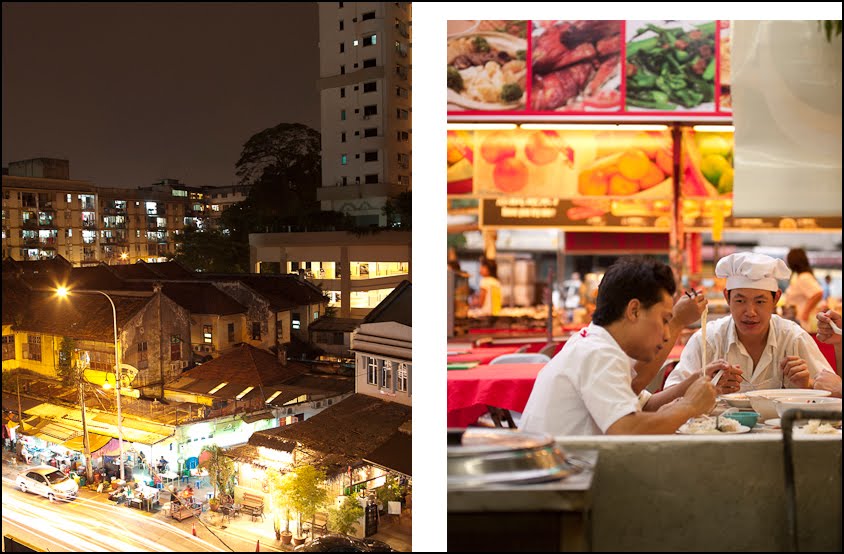
City of Nights: Singapore comes alive at night. The temperatures drop to mild upper 70s after days of 90...many days...everyday in fact. Singapore sits right on the equator just at the tip of the Malaysian peninsula, so the days are warm and consistent all year round. The Harbor plays a huge role, when just around dusk locals and tourists both descend on the the downtown area, apparently with one thing on the mind---FOOD!

Two of my favorite experiences were had in each of Chinatown's two hawker centers. The hawker stands are like street food, but nationalized, celebrated, cheap, and made nearly perfect by government health regulations. In fact, there so good that going to a fancy restaurant really is just a luxury of ambiance. The first stop was at the Maxwell food center, a spur of the moment craving to sample the famed Chicken Rice of Singapore. Delicious. $2.50 for almost half a chicken and a mounded plate of perfect chicken-infused rice. It turns out that I happened to stumble upon the same Chicken Rice stand that Anthony Bourdain went to for his show on Singapore food (fun to watch and down-loadable on itunes.)

The second (above) was on the first night of the Chinese Lunar New Year celebrations. It was like a Chinese, foodie Mardi Gras! The place was packed, and the Fried Oyster and Eggs we devoured alongside a couple giant Tiger beers set us straight. More below.


We spent a lot of our time near the Quay, which was once a rambling and rambunctious fishing and trade port part of town, and was founded by the British for that. Since the 1950s or so, the shipping and fishing has left the heart of town, and a very young, and quite westernized CBD has risen up in its stead. But even there, and even in the heart of the very young convention center near the harbor, there always seems to be a delicious hawker center right around the corner!


(From left: break-time near Clark Quay, a party scene, a little like Bourbon Street, only more welcome--though I am sad to say that there is a Hooters; middle, cool nook of a hawker center near the convention center; right: Boat Quay and the central business district. Below, local skaters.)


Thursday, February 12, 2009

January Travel Journal (3 of 4): Paris


My priorities were pretty simple in Paris. Spend time with our favorite friends there, find a good traditional croque-monsieur for weekday lunch, see the Seine, and perhaps squeeze in a soccer game (watched Bourdeaux win over Paris in a great game).

Gray weather kept our camera packed away for the most part, that and good long dinners. The above is at the Bibliotheque Nationale. It reminds me a bit of Milan Kundera, and I haven't decided which I like best, the above version or the one below. (Perhaps a vote is in order on the comments page.) The library hosted a pretty good exhibit "70' La Photographie Americaine" in their gallery. A bit more can be found here about the show. The show had an interesting collection of some of the majors like Arbus, Evans, Frank, Friedlander--Did anyone see that the Madonna photograph sold for twice it's expected price? It's amazing she was hired for $25 dollars for the photo shoot in '79 when she was strapped for cash--Mary Ellen Mark, Meatyard...And the show even had a Larry Fink image that looks a bit like an image PDN published in the '08 Photo Annual from his "My sexual safari" series.

A couple days later (and 2 croque-monsiers later), we made a quick stop by the Seine before leaving town.


Above, Xabi and Raphaelle, at the Seine. Below at home. (Two of our favorite subjects)


Some may have heard that much of France is a couple weeks into a strike against measures taken by Nicolas Sarkozy in the economy and in public works, including education. Both our friends are teachers in the French university system. We wish them well in their struggles.

Bonne Chance!

Wednesday, February 11, 2009

January Travel Journal (2 of 4): Belgium

(Nothing like a few artists, an alleyway/parking lot, and a bucket of paint to make things look particularly Flem-hip)

Two hours in Brussels, -4 degrees Celsius, and a few rolls to burn. The Galleries in Brussels must be incredible in the summer, full of warm air and light. In this year's deep freeze, the open air mall-meets-ornate-train station was filled with swift moving pedestrians and stylish overcoats.

Above, a cool bar/cafe on Rue du Marché au Charbon; Sommer (below), at ArSene/50 sent us to the Charbon area to find the cool cafes. (Sorry we missed the dance party, Sommer!).


(Bellow: The grand golden plazas in the heart of Brussels, a gorgeous gallery/mall, and Bar Fontainas.)


Belgium was a stopping point on our journey to see Jessie's brother Andy, who is studying in Leuven and recently proposed to Quinn. Cheers to you both!


Monday, February 9, 2009

January Travel Journal (1 of 4): Maastricht

(Destination: Masstricht?)

We arrived late in the small but super-dutch-chic Maastricht to find a frozen but happy town. (A good solid freeze can really wreak havoc on the train system in the area.) The hotel rooms were ablaze in red mood-light, a "big lip" sofa in the corner of the room, and out the window, a blend of industry, early 20th century hearths, and luminous rooftops. One could almost expect a shivering Ewan McGregor belting out some kind of musical while hanging from the moon.

Ah, the Netherlands.


Treaty of Maastricht, anyone?

Old-world Europe still reigns. I love shooting these old European towns in black and white. I can only assume the car was on loan for a film. Surely.


(The Meuse river bisects the town and feels a bit like crossing the Liffey each day. An old church in the center of town has been converted into one of the most inspiring bookstore/coffee shops ever.)


Too cold for trains, but the bicycles still work! I don't think the art of riding bicycles has been nationalized and perfected quite like this anywhere else in the world. Maybe, but the Dutch make it look so good.


(Clicking on the images will open a larger version of the pictures.)

Friday, December 19, 2008

Happy Holidays Home and Abroad!


Jessie and James wish you the very best. Cheers to all and to all a new and fantastic year!
May '09 bring, among other things:

the magic bus
the enchanted tourist
the wishful thinking
and of course...many oysters and many cheers


Monday, December 1, 2008

PRINT SALE OPENS TODAY!

As of this morning, our print sale "storefront" is open at our website.
Click on the tab "Print Sales" on the far right. We are offering 47 existing 11x14 prints for $40 each, including shipping. A holiday gift to our fans, while supplies last! Custom print options in several sizes are also available. We've put three pages of images up, so tool around and see if you see something you'd like, and we'll ship it out to you. I look forward to sending these pictures to their new homes.

Happy December!

Friday, November 14, 2008

It could be me

We've taken part in Paul Paper's global art project. Check it out
Here's how Paul describes the project:
"Could be me" is a project exploring possibility of one artist occupying another's space. It is a visual adventure and an interpretation of the same sentence by different artists worldwide .
Hundreds of artists created a piece which incorporated the sentence: "It could be me but it's actually Paul Paper." The website on the other hand, is named, "It could be paul paper, but it's acutally ____." The best way to experience the piece is to click on the names on the left at random to see how other artists incorporate this other identity into their work. Illustrators rule.

Paul, a photographer who lives in Vilnius, Lithuania, contacted us out of the blue, and sent us some gorgeous moody postcards. We shot our contribution in Kate's backyard, because it's looking a little Gothic these days, with the sudden change in season.